One in four tourists who visit Dubai returns within the same year. That figure, cited by Dubai Tourism officials during the 2025 World Travel Market London, is not simply a measure of satisfaction. It is a market signal. And the agencies that have noticed it earliest are quietly reorganising their entire operation around what that second visit looks like.
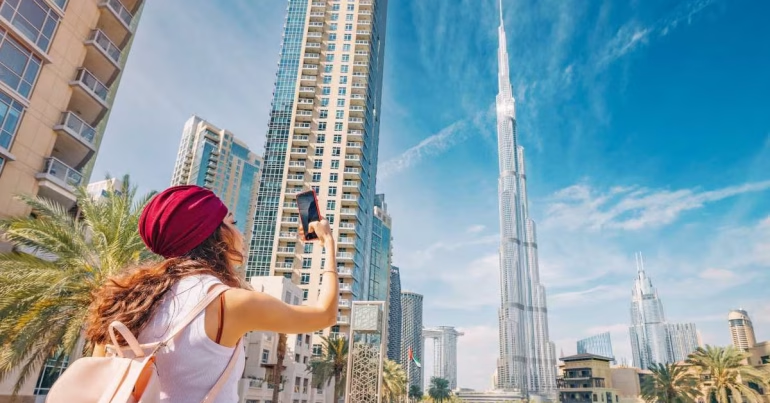
The first visit to Dubai follows a well-documented pattern. The Burj Khalifa observation deck. Dubai Mall. A group desert safari booked through the hotel concierge. A dhow dinner that may or may not have happened. The visitor goes home with photographs of a skyline they had already seen in a hundred photographs before arriving, and a vague sense that they saw the version of Dubai that was prepared for them rather than the city itself.
The second visit is different. And the industry has not yet caught up with how different it is.
Dubai welcomed 20 million international overnight visitors in 2025, a record for the third consecutive year. Hotel occupancy sat at over 80 percent, average daily rates continued to climb, and December 2025 became the first month in the city’s history to record more than two million international arrivals in a single calendar month.
Within those headline numbers sits a less-reported demographic that is reshaping what travel agencies in Dubai are being asked to do. The repeat visitor market is not a niche. If one in four of Dubai’s annual visitors returns within a year, the city is running a return visitor volume of roughly five million people annually, each of them arriving with a fundamentally different set of expectations from the first time they came.
They already know where the Burj Khalifa is. They do not need directions to Dubai Mall. What they are looking for is the Dubai that was not visible on the first visit, and they tend to arrive knowing that finding it requires local knowledge rather than an aggregator platform.
The contrast between first-visit and second-visit booking patterns is measurable. First-time visitors gravitate toward group tours, shared desert safaris, and the landmarks that appear in every piece of Dubai marketing material. Second-time visitors look for private experiences, smaller groups, and activities that require access rather than simply proximity.
The desert is perhaps the clearest example. A first-time visitor books a shared evening safari at Lahbab Desert (Red Dunes), which is the product that every aggregator promotes at the top of their search results. A returning visitor, having done that, is now looking for a morning desert experience at a, Dubai Desert Conservation Reserve (DDCR), Al Marmoom Desert Conservation Reserve, Al Qudra Desert, a private overnight camp, or a Liwa day trip to the Empty Quarter. These are not products that appear prominently on aggregator platforms. They require a conversation with someone who knows the difference between the options.
The same pattern appears across city experiences. A visitor returning to Dubai having already seen the Gold Souq will book a Deira heritage walk, an Al Fahidi neighbourhood tour, or a private dhow cruise on the Creek rather than the Marina. Someone who has already done the standard Burj Khalifa visit will ask about the view from QE2 at sunset or a rooftop that does not appear in any guidebook. These are experiences that require an operator with genuine local knowledge and the flexibility to build an itinerary around a specific request rather than a pre-packaged product.
The structural reason that repeat visitors tend to end up with local agencies rather than large operators or OTA platforms is straightforward. Aggregators are built for high-volume standardised products. They optimise for the experience that most visitors want, which is the first-visit experience. Their ranking algorithms, their pricing models, and their inventory management are all calibrated around group tours with fixed departure times and fixed itineraries.
A repeat visitor who calls an aggregator platform to ask for a private morning desert safari with a specific departure time and a request to visit Lahbab Desert rather than the standard location will find the platform has no good answer. The product does not exist in the catalogue.
Local agencies with physical operations in Dubai and their own guides and vehicles are where this conversation leads. A travel agency in Dubai that handles its own fleet, employs its own guides, and builds itineraries around client requests rather than fixed catalogues is structurally better placed to serve a repeat visitor than any platform built for standardised first-visit demand. The booking typically happens on WhatsApp rather than through a website, which is itself a signal: repeat visitors have already learned that the experiences they want require a direct conversation, not a search filter.
The emergence of a substantial repeat visitor market is a mark of destination maturity. Cities that attract visitors once are destinations. Cities that attract them back are homes, in the loosest sense, places that people feel they have a relationship with rather than simply a completed itinerary.
Dubai is becoming the second type of city. The D33 Economic Agenda, which targets 25 million annual visitors by 2030, is partly built on this assumption: that the city’s growth will come not just from new source markets but from deepening the relationship with visitors who are already engaged. The investment in cultural infrastructure, in the expansion of the Louvre Abu Dhabi and the development of Al Seef and Al Fahidi as heritage districts, in the formalisation of Emirati cultural experiences through the Department of Culture and Tourism, all of it is oriented toward giving the repeat visitor a reason to come back that the first-time visitor could not have anticipated.
The agencies that have understood this earliest are the ones investing in what cannot be standardised: guide knowledge, itinerary flexibility, and the capacity to build an experience around a specific request from someone who already knows the city well enough to ask a specific question. That is not a product problem. It is an operations problem, and it requires a different kind of business to solve it.
The repeat visitor market in Dubai is still in an early phase. Most visitors arriving for the second time still book through the same channels they used the first time, which means they often end up with the same experience they had the first time and leave disappointed. The industry has not yet created adequate discovery infrastructure for what a second visit should look like.
What is clear is that the market exists, that it is substantial, and that the businesses best positioned to serve it are not the ones with the largest catalogues but the ones with the deepest local knowledge. Dubai’s tourism story has always been told through record numbers. The more interesting story, increasingly, is about the visitors who keep coming back and what they find when they do.



The UAE can be overwhelming at first — in the best possible way. Between Dubai's skyline, Abu Dhabi's culture, the deserts, the souks, and the sheer variety of things to do, knowing where to start isn't obvious. Our guides are written to help you make the most of your time here, whether you're staying for a weekend or a month — without the usual tourist traps.