If you go into any pharmacy in Dubai, you will see a whole shelf full of teeth whitening strips, pens, powders and LED kits. While some of these products do have an effect, to a certain extent, the packaging omits the reason why they work for some people and not for others, what they are unable to achieve, and where the boundaries of at-home teeth whitening lie.
The article explains both methods, the home treatment and the clinic treatment in simple terms so that you can make your decision with full awareness.
Tooth colour is due to two layers, the enamel on the outside being slightly translucent and the dentine lying underneath which is naturally yellow. As time goes on the enamel becomes a bit thinner and more of the dentine is visible, and this is one of the reasons why teeth turn darker with age even in people who brush their teeth well.
In addition, there are surface stains. Coffee, tea, karaak, red wine, turmeric in food and tobacco all leave a colour both on and just beneath the enamel. It is these stains that most whitening products are designed to deal with.
Another group are located deep within the tooth: these consist of stains caused by certain antibiotics taken in childhood, excess fluoride during the development of the tooth, or a tooth that has died as a result of an injury. None of the tooth strips can reach them, and even professional bleaching might only have the effect of softening them.
Almost all tooth-whitening products, whether they are obtained from a pharmacy or a dental clinic, are based on the same chemical principle: hydrogen peroxide or carbamide peroxide. These peroxides release oxygen molecules, which break the bonds of the stain compounds within the enamel, thereby making the stains less visible.
The main difference between the products lies in their concentration and how well the gel remains in contact with the tooth. The over-the-counter strips available in the UAE generally have a low peroxide content, intentionally so because the product is used without supervision. The smaller amount results in a more gradual and milder change, and it also means that the outcome reaches a limit.
The case of toothpastes that whiten teeth and charcoal powders is different. Most of them contain only small amounts of peroxide and function through gentle abrasion. They do not alter the natural colour of the tooth, and excessive use can lead to the wearing away of the enamel.
What is usually left out of the packaging is the following.
The strips only whiten the areas that they come into contact with. A flat strip is placed on the front surfaces of your front teeth, but it seldom covers the edges, the gaps between the teeth or anything behind the canines. As a result, some people end up with a bright centre and sides that have not changed, producing a patchy appearance when they smile widely.
Fillings and crowns do not change colour. Peroxide has no effect on composite, porcelain or ceramic. Natural teeth around a front filling or crown may lighten while the restoration stays where it was, and the mismatch can be more noticeable than the original discolouration.
Sensitivity is common and difficult to deal with on one’s own. Since peroxide temporarily creates small openings in the enamel which connect to the nerve, cold water and even sweet foods can cause pain for a day or two. A dentist is able to use desensitising agents and make adjustments to the timing of your teeth. At home, most people just give up using the strips and so lose the progress they’ve made.
Gum irritation occurs when the gel comes into contact with the soft tissue, and the strips are all the same size. The gel that squeezes onto the gum line may cause white patches and soreness. In the clinic, a protective barrier is painted along the gums and custom trays are made to keep the gel off the soft tissue.
No one has looked into the reason why your teeth are stained. That’s the main point. A grey tooth could indicate a dead nerve, while a brown spot might be an early sign of decay. If you have whitening done over a cavity, the peroxide could be pushed towards the nerve, and this might result in pain. A brief examination prior to any whitening will rule those issues out.
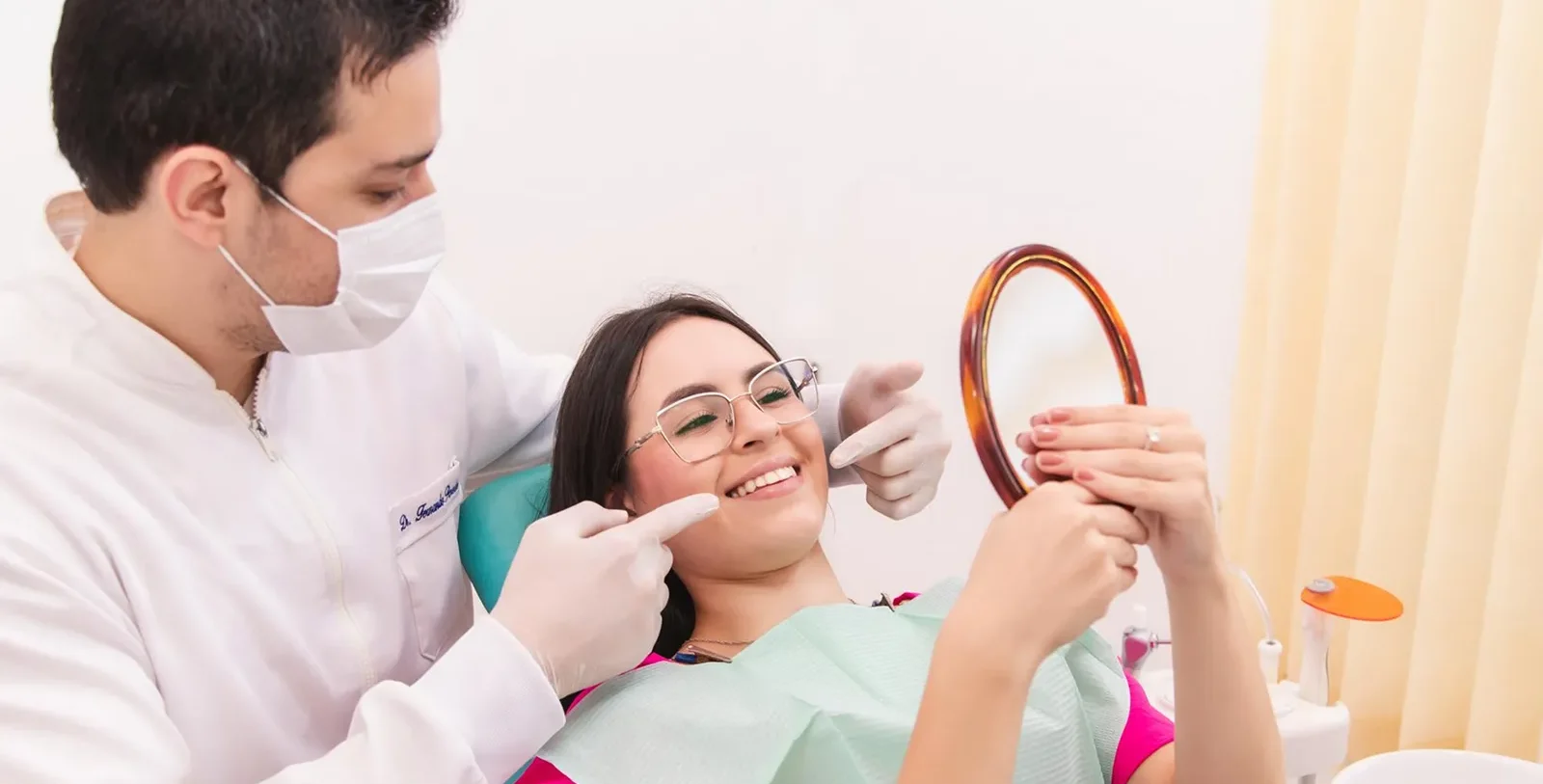
In Dubai, teeth whitening at a clinic begins with an examination rather than with the use of gel. The dentist checks for any decay, cracks, gum disease, exposed roots and any existing restorations. If a cleaning is required, it is generally carried out first since carrying out bleaching on plaque and tartar would result in an uneven finish.
The initial shade is determined using a shade guide or by taking a photograph so that you can see the change later on rather than having to guess. The dentist then tells you which shade is realistic for your teeth, and a person who has deep internal staining will be clearly informed that the improvement might be slight.
There are two typical options. The first of these is to receive a custom take-home kit. A digital scan or an impression is taken in order to produce trays that fit your teeth exactly, and you then use a gel supplied by the dentist at home for a fixed number of days. The trays fitting properly means that the gel spreads evenly over all the teeth and does not come into contact with the gums.
The other option is to have the whitening carried out entirely at the clinic during one visit.
Zoom teeth whitening is a commonly used in-office treatment. The appointment typically lasts between sixty and ninety minutes. Once the lips and gums have been protected, a gel containing a higher concentration of peroxide is placed on the teeth and then activated by means of a special lamp. The lamp is not responsible for the whitening; rather, it accelerates the reaction of the gel. The gel is applied in a number of short cycles, with the dentist examining the teeth between each cycle.
Since the concentration is greater and the procedure is kept under the supervision of a professional, the degree of tooth whitening achieved during a Zoom treatment is usually more significant than that obtained by using strips over a number of weeks. It is common for patients to have the treatment done before a wedding or some other major event since they want to see noticeable results in a single session. It is normal to experience some sensitivity for a day or two afterwards, and patients generally receive maintenance trays when they leave the clinic to help maintain the effect.
At Magnum Dental Clinic’s JLT branch, every whitening treatment begins with that examination step described above rather than going straight to the gel.
Whitening is generally postponed during pregnancy and breastfeeding, because there is limited research on peroxide use in those periods. Children and teenagers whose teeth are still developing are usually asked to wait. Anyone with untreated decay, active gum disease, worn enamel or very sensitive teeth should have those issues addressed first.
In your case, if the discolouration affects only one tooth or if that tooth has already had a root canal, then an alternative procedure such as internal bleaching or the fitting of a veneer might be more appropriate than general whitening; a dentist will be able to advise you as to which situation applies to you.
There is no whitening method that will last indefinitely; the results generally remain for several months or up to a couple of years, the exact duration depending on one’s habits, and some factors can help extend that period:
People who smoke will notice the effect wear off more quickly. It’s important to be aware of this before spending money on either the strips or a clinic visit.
Whitening strips are a sensible first choice when dealing with mild surface staining on healthy teeth, provided that you know their limitations. They won’t whiten every tooth, won’t affect fillings or crowns, and can’t inform you whether the stain you’re trying to remove is an indication that some treatment is needed. Clinic-based teeth whitening, whether using custom trays or having a Zoom treatment carried out in the chair, includes the examination, the proper fit and the supervision that are missing from the over-the-counter kits. A brief consultation is held first to decide on the appropriate method before you decide to go ahead with one of them.
Name: Magnum Dental Clinic – JLT
Address: Shop No. 2, Indigo Tower, Cluster D, Al Thanyah Fifth, Jumeirah Lakes Towers, Dubai, United Arab Emirates
Phone: +971 54 452 2332





Living in the UAE as an expat comes with its own set of rules, procedures, and unwritten norms. Whether you've just arrived or have been here for years, there's always something to figure out — from renewing your visa and opening a bank account to finding the right school or navigating the healthcare system. We cover the practical side of life in the Emirates so you can spend less time on bureaucracy and more time actually enjoying it.