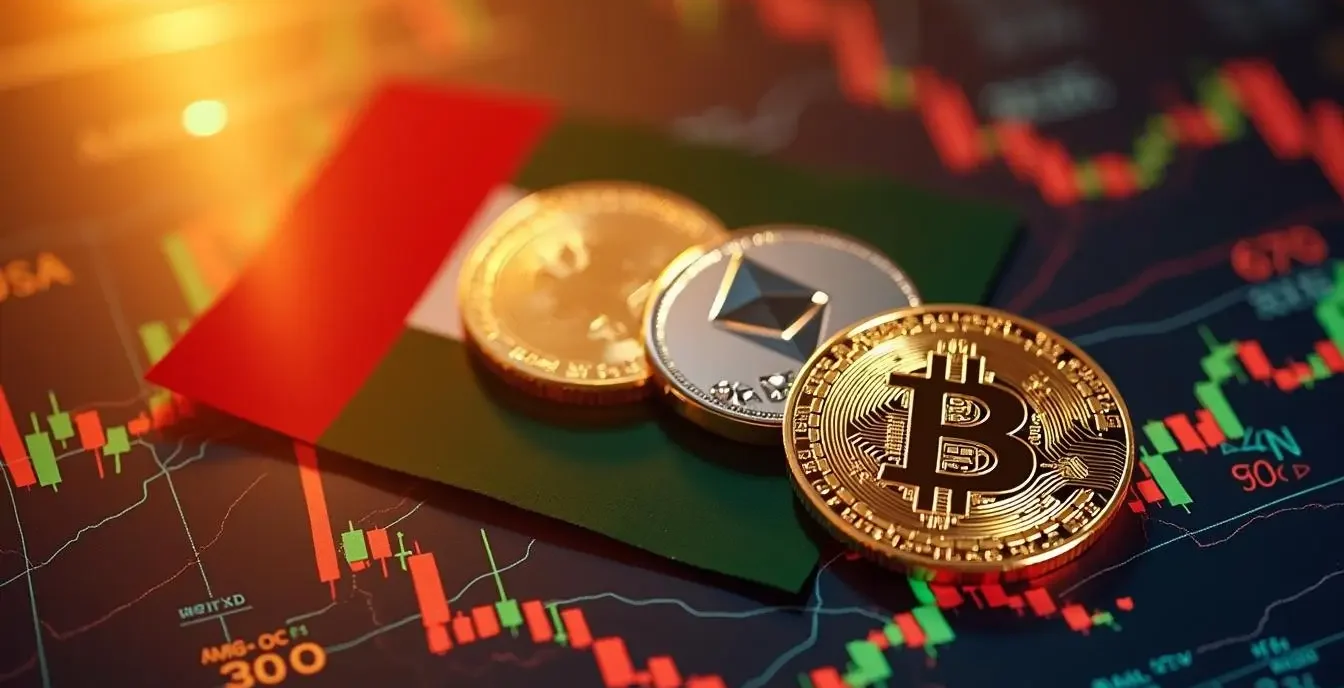
For many people in the UAE and across the Gulf, sending USDT has become as routine as a bank transfer. Freelancers get paid in it, families use it to move money across borders, and traders shuttle it between exchanges several times a week. Yet very few users pay too much attention to what each transfer actually costs them. Or know that the same payment can cost thousands of times more depending on which network they pick.
A new reference tool launched in Dubai aims to change that. The Crypto Fee & Transfer Index went live in October 2026. The index shows in real time what it costs to send USDT, Bitcoin, and seven other major cryptocurrency coins.
It also highlights which of the nine major exchanges featured is cheapest to withdraw from. It’s free, needs no sign-up, and carries no adverts or tracking.
It’s also believed to be the first live crypto fee index published in Arabic. Every page is available in a full right-to-left layout at crypto.gulfarcade.com/ar/.
The index was built around one problem: most people choose a network out of habit rather than price.
“Most people send USDT on Tron out of habit. Right now that habit can cost them a thousand times more than the same transfer on Solana,” said founder Tom Hannon. “We built the index so nobody has to guess.”
The live figures back him up, and the gap can be even wider. On 13 November, the index showed that sending $100 of USDT from your own wallet cost about $2.01 on Tron. The same transfer cost $0.0004 on Solana, $0.0011 on BNB Smart Chain, and $0.015 on Ethereum. At that snapshot, Tron was roughly 5,000 times more expensive than Solana.
Two dollars may not sound like much. For someone sending small amounts regularly, such as a remittance every week or several transfers between exchanges a day, it adds up quickly. And because network fees are flat rather than a percentage, they hit small transfers hardest. A $2 fee is 2% of a $100 payment, but only 0.02% of $10,000.
One of the index’s main jobs is to separate two costs that users often confuse.
The first is the network fee, which the blockchain itself charges to process a transfer. This depends on the network and on how busy it is, and it can change from one hour to the next.
The second is the exchange withdrawal fee, which an exchange charges when you move coins off its platform. This is set by each exchange, often differs by network, and can be much higher than the network fee itself. On 13 November, for example, the cheapest USDT withdrawal on Tron among the nine exchanges was 1.3 USDT at Bybit. The cheapest on Arbitrum One was just 0.003 USDT at OKX.
The index shows both, so users can see the full cost of a transfer before they make it. A calculator and a comparison table rank the cheapest routes and show what each fee works out to on $100, $1,000, and $10,000 transfers.
The index tracks nine coins: USDT, USDC, BTC, ETH, SOL, BNB, TRX, TON, and POL. It covers eight major networks that Gulf users rely on: Tron, Ethereum, Solana, BNB Smart Chain, Polygon, Arbitrum One and TON.
It also compares nine exchanges widely used in the region: Binance, Bybit, OKX, KuCoin, Bitget, Rain, BitOasis, CoinMENA and Crypto.com.
Network fees are measured on real transfers through public blockchain nodes and refreshed every 15 minutes. Exchange fees are read from the exchanges’ own APIs every six hours, or checked manually against their published fee pages, and every row shows when it was last verified.
At a time when many crypto comparison sites are paid listings in disguise, the index puts unusual weight on showing its working. All of its numbers are published as open JSON data, and a methodology page explains each calculation and links to the source.
“Every figure on the site can be traced to a blockchain node or an exchange’s own API, and we say when we last checked,” Hannon said. “If a source goes down, we tell you rather than hide it.”
For Gulf users, the cost of a transfer is only half the question. The other half is whether the exchange is allowed to operate where they live.
Each exchange page includes a dated Gulf licensing table, verified in October 2026 against the public register of Dubai’s Virtual Assets Regulatory Authority (VARA) and the regulators’ own announcements. The tables show which exchanges hold full licences in Dubai, Abu Dhabi and Bahrain, which have only in-principle approval, and which have been fined or ordered to stop.
That matters in a region where the rules have moved quickly. The UAE now has dedicated regulators for virtual assets in Dubai and in Abu Dhabi’s financial free zone, and Bahrain’s central bank runs its own licensing regime. An exchange’s status can differ from one emirate or country to the next, and it can change. Putting that information next to the fee data, with a clear verification date, saves users from checking several regulators’ websites themselves.
The index also offers free embeddable widgets that show its live numbers on any website or Telegram landing page. The widget refreshes itself, contains no tracking, and comes with no fee, sign-up, or usage limit.
For users who don’t want to check the site every day, a free Telegram channel, t.me/cryptofeeindex, posts the cheapest way to send USDT and Bitcoin every morning. It also sends an alert the moment a network’s fee jumps or falls sharply.
The index doesn’t recommend any exchange or network, and it describes its data as information rather than advice. But its figures point to a few simple habits that can save regular senders money:
For a region where crypto has quickly moved from niche to everyday use, a free, bilingual tool that shows the real cost of each transfer fills an obvious gap. The question for many users will be how much they’ve been overpaying until now.


Living in the UAE as an expat comes with its own set of rules, procedures, and unwritten norms. Whether you've just arrived or have been here for years, there's always something to figure out — from renewing your visa and opening a bank account to finding the right school or navigating the healthcare system. We cover the practical side of life in the Emirates so you can spend less time on bureaucracy and more time actually enjoying it.